


Updated 1/13/2026
When organizations face a financial crisis, the instinct is often to double down on development. Hire a new fundraiser or consultant! Launch another campaign or big event! Find a major donor who can cut us a big check!
This is unicorn thinking.
Yes, I acknowledge total charitable giving (in dollars) in the U.S. hit a record $592.50 billion in 2025 (up 6.3% from the prior year). But that headline masks a more troubling reality: the number of individual donors in U.S. has declined every year since 2019. This means the money is coming from fewer and fewer people (who probably have a few focused interests already in mind).This means
Looking a little closer, In 2025, the number of donors fell another 3%. Small donors (those giving under $100, who make up over half of all donors) dropped by more than 10% in a single year. Retention rates sit around 18%, meaning more than 80% of the donors you acquired this past year probably won’t give again next year.
And, depending on your mission, the math can get even more brutal
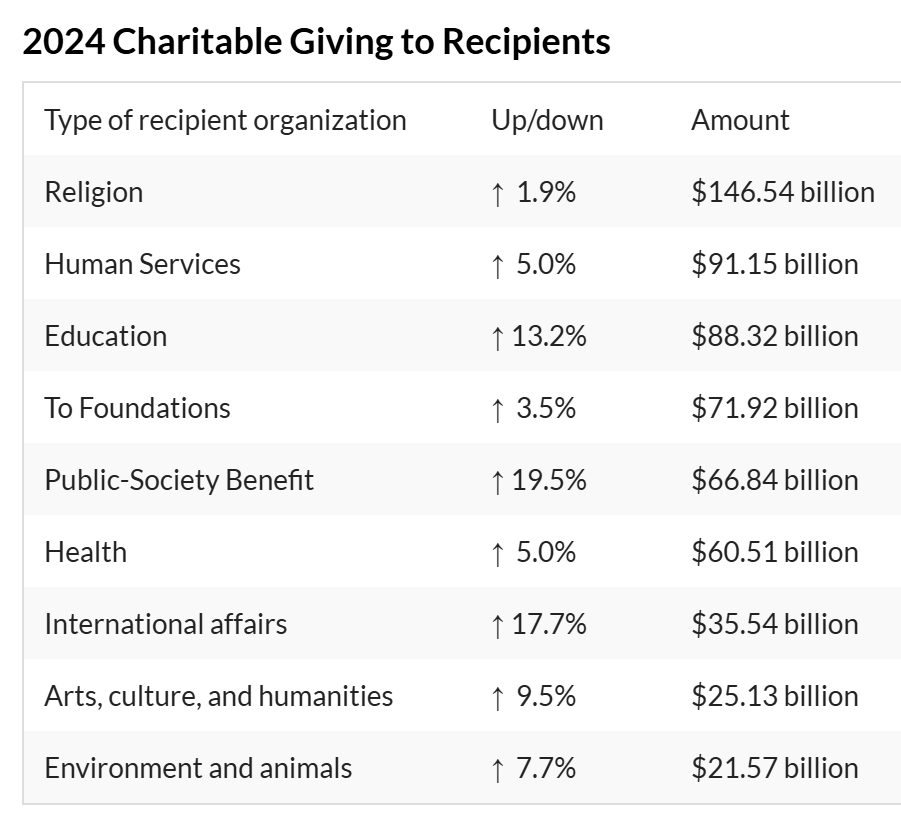
In 2024, Arts, culture, and humanities receive just about 4% of total charitable giving… roughly $25 billion out of $592 billion donated. Religion gets 23%. Human services and education each get 14%.
You’re not competing for the pie.
You’re competing for crumbs of the pie.
Boards, take note:
You need to stop thinking that a new CEO or development consultant will magically unlock major gifts… especially if the donor relationships weren’t cultivated.
There is no email to MacKenzie Scott that is going to pay out. (I’ve literally been asked why don’t we do this?)
There is no grant application that closes a structural deficit in 90 days, or 365. Foundation funding can take 12-18 months to develop, if not more.
Corporate sponsors want visibility with success and feel good stories, not rescue missions.
And Individuals making major gifts require years of stewardship that either happened... or didn’t. And you can’t change that overnight.
✨The Big Lesson
Fundraising is a lagging indicator. It reflects the quality of relationships your organization built over the past three to five years.. . If those relationships weren’t built, no amount of urgency or strategic planning can substantially change that timeline. (Luck might.)
To be clear: I’m not saying development doesn’t matter. It just means development can’t save you right now. If money is the crisis, you need to buy time through cuts, renegotiations, and strategic hard decisions…
You need to survive first. Then build the fundraising infrastructure that prevents the next crisis.
Want to read more?
Giving USA 2025: Total charitable giving reached $592.5 billion in 2024; arts/culture/humanities received 4% ($25.13 billion)/↑ 6.4%;
AFP Fundraising Effectiveness Project Q2 2025: Donor counts declined 1.9% year-over-year; small donor participation ($1-$100) fell 10.5%; retention rates at 18.1%
Chronicle of Philanthropy: “Donors Down, Dollars Flat” (2025): Donor counts have declined every year since 2019; 4.5% decline in 2024