

As an interim executive, every twelve months or so I’m dropped into an organization I’ve never seen from the inside… and I have to move fast. I need to get to know the business. Build trust. Identify the team I need or shore up the one I have. Figure out what early wins are possible. Garner support across the organization… And I need to do all of it quickly, because unlike a permanent hire, I don't have the luxury of a long runway. My value depends on being effective in less time than most long term leaders get for their listening tour.
Here’s the big lesson learned over the course of nine executive assignments: How I build trust, how fast I move, who I talk to first, how I collect information all depends on the situation I’m walking into. Showing up the same way in a turnaround as I would in a healthy, growing organization isn’t only less effective, it would be damaging.
Any executive leader stepping into a new role needs to assess the business situation before they can determine the right strategy. The problem is that most people don’t make enough transitions in their career to develop strong instincts for it… so they default to what worked for them last time. And that's often where the struggling starts, or worse, where leaders fail and find themselves out the door.
So this is exactly where a good framework can be of help. Today I’m sharing with you the STARS model, which I first came across in Michael Watkins’ book The First 90 Days. Though that was almost ten years ago, I still pull it out every time I step into a new role. It helps me get my bearings and start acting quickly and confidently.
🔖(This is a long one, so bookmark it and come back when you’re ready to dive in!)
The Five STARS Situations
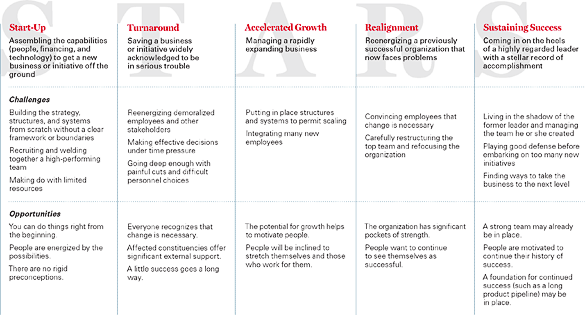
STARS stands for Startup, Turnaround, Accelerated Growth, Realignment, and Sustaining Success. These are five fundamentally different business situations, and thus require fundamentally different approaches to leadership. The model isn’t about neat lines and tidy boxes. Every situation you walk into will be unique… But the five situations here will give you a common language and a starting point. They help you find patterns more quickly, anticipate common challenges, and make better decisions before you have the full picture.
I’m not going to go deep-dive into each, but here is a high level overview.
Startup
If you’re in a startup situation, you’re building from scratch. On the upside, teams here usually bring high energy and enthusiasm for the mission, and you’ll get to take action without having to navigate legacy or bad habits. On the other side, structure will likely be weak, processes manual, resources tight, and culture? While full of potential, it can quickly spiral into misalignment if you’re not deliberate about it early. Expect to be hands-on and all-in.
⭐Leadership Tips
Be decisive about what matters, and flexible about everything else. Save conviction for the things that are truly foundational in these early stages.
Establish the fundamentals early. Culture, priorities, ways of working will form whether you shape them or not. Set your expectations clearly and hold people to them from the start.
Own hiring and onboarding. Culture-setting begins during recruitment, and ripples out. A bad hire in a small team does big damage, so you’ll want your attention here.
Stay focused on your core opportunities and problems. There will be an endless number of doors you could walk through. Be discerning about which ones you open. Losing the plot in the frenetic energy of a startup is easier than it sounds.
Pilot before you commit. Early decisions have a way of becoming foundational, for better or worse. Take smaller bites, test ideas before scaling them, and don’t get attached to anything that doesn’t have the data to back it up.
Know yourself. A startup will test your stamina and your ego. Set realistic boundaries around your energy, own your strengths and weaknesses, and ask for help before you need it.
Delegate early, even when it’s uncomfortable. You cannot be everywhere, and trying to be will slow the most important things down.
Turnaround
The organization is in crisis and something has to change, and it has to change fast. Maybe funding has been pulled or a program failed or your leadership team collapsed. The pressure is intense, the timeline is short, and the stakes are high. Paradoxically, this can actually be one of the more straightforward situations to lead into. When things are clearly broken, people are primed to be led. They want direction and even small wins generate momentum. But make no mistake…. hard calls will have to be made, and quickly.
⭐Leadership Tips
Triage! Deal with critical survival issues before anything else. Do you have enough cash? Can you make payroll? Are there a major grant or donor about to walk? Is there an accelerating staff exodus? Don’t take up large-scale, long-term transformation projects, such as launching a new programming or strategic planning, until the foundation is stable.
Get consensus on the diagnosis before you reach for solutions. Don’t assume shared understanding just because there’s shared panic. Deep dive into the data, talk to staff at every level, and determine whether the problem is strategic, structural, cultural, or some combination. You don’t have time to treat the wrong problem.
Secure early wins, as you need credibility and momentum in order to be effective. If there are obvious pain points you can resolve with a quick decision, make it… and then advertise it. (As Stephen Covey says about building trust: say what you’ll do, do what you’ll say, and advertise!)
Learn your ‘power grid’. Figure out who actually influences the team… both directly and softly. I’m talking staff culture-keepers, board leaders, major donors, key stakeholders. You’ll need them on your side because formal authority only gets you so far.
Get the right team in place fast. Identify your strong leaders and change champions early, ally with them, and position them where they can have the most impact. Where you find serious, entrenched resistance… move them on. If left in place, resisters will undermine everything you’re trying to do.
Over-communicate. Silence breeds panic in a turnaround. Be transparent about what you’re doing and why. Test ideas with a small trusted group, but communicate broadly and often.
Manage your energy. Turnaround environments are exhausting. Closed doors, time pressure, high emotion — it accumulates fast. You cannot lead well on empty. Protect yourself.
📌PS. I wrote about leading through crisis a little while back, with more detailed advice.
Accelerated Growth
Things are working … and working well! The organization is growing fast, demand is strong, and there’s real momentum behind the mission. This is an exciting place to lead. The challenge isn’t fixing anything, but to build the infrastructure and team that can support ongoing growth
⭐Leadership Tips
Build ahead of the growth. Systems and structures need to be in place before you need them, not after. Anticipate what the next stage requires and start building toward it now… and don't fall into the trap of holding onto ways of working just because they're familiar. What got you here won't always get you there.
Tend to your culture. As you bring people on, it becomes more important than ever to ensure new team members are really integrated… and that your values are consistent universally across the org.
Shift from operator to orchestrator. As the organization grows, your job changes. You can no longer be close to everything… and you shouldn’t be. Build systems and develop leaders who can make good decisions without you in the room.
Put the right people in the right roles. Growth creates new roles and new demands. Assess honestly whether your team has what the next chapter requires, and invest in developing them or bringing in new talent where needed.
Over-communicate. Alignment happens naturally on small teams. It doesn’t at scale. You need to be consistent, and you need good downline discipline.
Realignment
This is a sneaky one, and in my experience, the most underestimated. Things aren’t on fire… but they’re drifting. The organization was successful, maybe still looks successful on the surface, but the signs are there if you look closely. Donor retention is slipping or financials are trending negative. Program participation is flattening. Staff turnover is increasing. The mission is starting to feel tired. This is the stage before a turnaround, and the defining challenge isn’t fixing a crisis, it’s convincing people one is coming. You’re fighting complacency, and sometimes willful blindness.
⭐Leadership Tips
Lead with facts. People won’t accept a problem they can’t see. Use data, benchmarks, and external assessments to make the case objectively of the current situation.
Create urgency without creating panic. Your job is to shift people from things are fine to we need to act … without triggering fear. Name the moment as an opportunity, use data, and avoid over dramatization.
Shore up culture, systems, and skills. Unlike a turnaround, the strategy here is often still sound. What needs attention is how people and systems are working together or what capabilities are missing.
Bring in outside voices. External perspectives, consultants, advisors, peer benchmarks, can help you say things you can’t. Use them to validate and amplify your case for change.
Rebuild the top team where needed. Surround yourself with people who can see the drift and are willing to fight to correct it. Resistance at the leadership level will kill your efforts.
Be patient but persistent. Realignment takes longer than a turnaround. Change here is deliberate and gradual. Don’t mistake slowness for failure… but don’t let patience become an excuse for inaction either.
Sustaining Success.
You’re inheriting something that is really working! The mission is clear, the team is strong, the funders are giving and happy, and your predecessor left big shoes to fill. This might sound like the easiest situation to walk into… but it comes with its own kind of pressure. With high expectations from all sides, many leaders are tempted to make their mark by changing things. But that instinct can be dangerous. The organization doesn’t need (or want) disruption. It wants continuity and steady leadership.
⭐Leadership Tips
Resist the urge to change things for the sake of it. You were brought in because something is working, so be sure to understand what that is before you touch it.
Honor what came before. By acknowledging the legacy of your predecessor, you can build trust and signal that you’re a steward (not a bulldozer).
Listen before you lead. Your credibility here will be built through curiosity. Take time to understand why things are done the way they are before deciding what should be different.
Keep the team motivated. Success can breed complacency, so your job will be to keep people energized and connected to the mission.
Invest in what’s next. Sustaining success doesn’t mean standing still. Start looking for the next evolution, including new opportunities, emerging risks, the question of what this organization needs to become in 5-10 years.
Develop your people. A healthy organization is the right moment to invest in leadership development and succession planning. Build the bench while you have the runway to do it well.
Using the STARS Model as a New Executive
As I said, I keep this model in mind whenever I start a new executive role. Here is some of my advice:
First of all, the diagnosis process starts before your first day. In fact, it begins when you’re interviewing for the role! You should research what’s publicly available, and make sure to ask targeted questions to the board of directors to get an early read on the organization. Some I like to use are:
What does the financial picture look like over the next 12 months, and are there any significant risks or pressures on the horizon?
How would you describe the organization’s culture right now, and how has it changed in the last few years?
Are there any major strategic decisions either on the horizon, or have been delayed?
Where do you think the organization is falling short of its potential?
How aligned is the leadership team and board around priorities and direction?
What has to go well in the next 90 days for this to be considered a successful transition?
If you’re being completely honest… what’s the one thing you’re most worried about?
Second, take those answers with appropriate skepticism. Everyone has a perspective, and no single conversation gives you the full picture. Especially if you’re interviewing with a Board, where their visibility into the organizations day to day can be limited. So be sure, when you walk in through the door, to further validate, pressure-test, and fill in the gaps.
Finally, I also think its important to know yourself. Not every leader is built for every business situation. Turnarounds require a different kind of leadership skillset than a start-up . Some people thrive in chaos and grow bored in stability. Others are masterful stewards of success but freeze up when hard calls need to be made. The leaders who are honest about the situations where they thrive and where they don’t, tend to be the ones who do their best work. You need to know when to walk away from a role simply isn’t the right fit.
A final thought…
The biggest trap in any leadership transition is assuming what worked last time will work this time. Maybe it will. But you shouldn’t assume. Every situation is different, and the leaders who struggle most are usually the ones who never stop to ask what this moment actually requires of them.
STARS doesn’t give you all the answers but it can get you started in the right direction, faster.
🔗Read more! An HBR article by Michael Watkins can be found here, and you can of course pick up a favorite book of mine, The First 90 Days where he talks about it, and other transition strategies, too!
🔗You might also enjoy: People Work in Nonprofits Because They Can’t Cut It in ‘Real’ Business and Nonprofit Means No Profit!
Fantastic insights! Having been an interim many times, your analysis resonates with my experience. I’m a big believer in Susan Kennedy-Stevens work around nonprofit lifecycle thinking, but hadn’t applied stage-based thinking as effectively as you have to the interim leadership context.
How long does it take you to assess the business, generally speaking? Great article - keep up the great work!