

Most nonprofit closures don’t happen over night. Nanowrimo’s collapse was years in the making. This is the story of what went wrong, and what every executive and board member can learn from it.
Every November for most of the 2010s, people around the world attempted a crazy challenge: to write a 50,000 word novel in just 30 days. What began as a small experiment among friends quickly became an international movement, with more than 400,000 participants, complete with paid staff and student programs and summer events. Hundreds of volunteer leaders organized local ‘write-ins’ and buildt regional communities. Books were published. People were inspired. I mean, by many measures, NaNoWriMo (short hand for National Novel Writing Month) looked like a success story.
And, holding it all together was a set of shared values: that creativity matters, that anyone can tell a story, and that showing up for your art counts.
… So when leadership began making decisions that seemed to contradict those values, you can imagine how quickly things slid south. In fact, it only took five years for NaNoWriMo to go from international success to doors shuttered.
Let’s dive in…
(This case study is particularly poignant for me, as I personally participated in NaNoWriMo nearly every year from 2006-2018. I wrote and cheered other writers on… and even recommended NaNoWriMo to my friends. It was small and magical and now, sadly, gone.)
🤸♀️Jump to a section:
Case Recap: 3 governance failures that compounded into collapse
No organizational failure is black and white… and what brought Nanowrimo down wasn’t one catastrophic mistake… it was multiple ones, compounded over years, each making the next one harder to survive.
Failure #1: Declining financial and program performance
This is the problem that amplified the impact of all other problems.
For four of it’s final six years, Nanowrimo operated at a deficit, surviving only because of a loan taken out during the pandemic. The majority of revenues were from merchandising and sponsorships, which was risky on it’s own, and individual giving was on a multi-year downward trend. By 2023, the organization was nearly out of cash, with very little runway left to course correct. A board reviewing financial and programmatic performance regularly should have caught this trend far earlier and demanded a plan.
Look, lots of organizations struggled post COVID… and had this been the only challenge, Nanowrimo might have survived. It had a loved brand and a committed community. A transparent call for help might have worked.
But they never had a chance to get ahead of it because… problem number 2 arrived:
Failure #2: No safeguards for children
In 2023, the board received complaints about child endangerment and staff misconduct. They quickly launched an investigation and shared findings 10 days later. On the one hand, impressive speed. But what they uncovered was alarming: no background checks, no child safety training, missing data protections, and lack of moderation across broader community platforms. The board then went on to make changes to leadership and implemented a remediation plan.
So far, a reasonable response.
But then, the new volunteer agreement they released to address these gaps was found to protect the organization more than the volunteers. When volunteers pushed back, the organization removed all of them from their systems.
And just like that, hundreds of regional communities and brand trust, built over years, disappeared overnight.
The community was fracturing. And then came the final blow.
Failure #3: Misaligned messaging
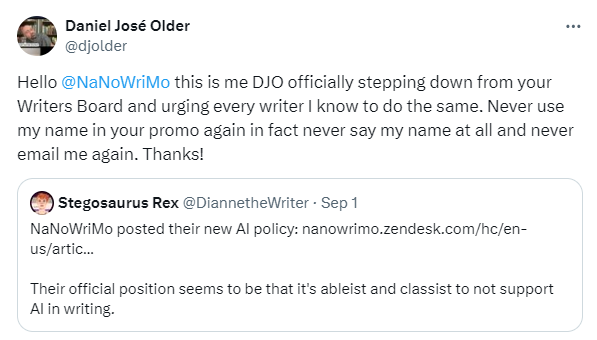
Facing a cash shortage and a shrinking base, NaNoWriMo sought new sponsors to keep afloat, including an AI writing tool company. They released a public statement essentially endorsing AI writing, and then went a step further to say that anyone who condemned AI was being ‘classist and ableist.’
Supporting AI in a writing community is a rocky position on its own… but calling critics classist and ableist is a different kind of mistake, and using marginalized communities as a shield for a sponsorship decision was met with rapid fire. NaNoWriMo later acknowledged the misstep, but with a tone that was perceived as blaming the community for the backlash.
Cue the end credits:
At this point, major media was all over it. Board members began resigning.. publicly and loudly. Community members spoke out. ..but the message from the organization read as: if you don’t like it, you can leave.
So people did.
Lessons Learned
Good governance can’t prevent every crisis, but it does create the conditions where you are more likely to catch problems early. Any one of those issues Nanowrimo faced could have been survivable. Maybe all of them, if handled with transparency, humility, and sensitivity. But all we can do now is learn from their mistakes.
Here are some lessons I see in this case, and things you should be thinking about as a board member.
Lesson 1️⃣: You need strong financial oversight with easy to understand reports.
A key responsibility as a board member is to provide oversight of the organizations finances. I don’t mean managing the numbers day to day, but making sure you are getting the right information at the right time, in a way that is legible. Then, ask questions if anything seems off and take action. A few things you can be doing as a board include:
Use a dashboard to track key program and financial metrics, and review it every quarter.
Look at trends across the last 3-5 years. A bad quarter is easy to explain, but a three year+ slide tells a different story.
Ask hard questions of management if things aren’t tip-top. What’s driving the problem? What’s the plan? Don’t accept vague assurances.
If management isn’t acting on concerning trends, demand a course correction.
Share your financials publicly. Go a step farther to ensure they are easy to understand. This builds donor trust.
Know your revenue risk. If most of your income comes from one or two sources (e.g. a single donor or set of contracts), that’s a red flag you need to have a plan for.
Lesson 2️⃣: You need safeguards when working with kids
If your organization works with minors in any way, your board needs to ensure there are protective policies and practices in place, and that those practices are monitored and held to the highest standard.
Require background checks for staff & volunteers (and board members!) who interact with youth. Confirm this actually happens.
Ensure child safety training is completed and tracked.
Maintain up to date data protection policies that takes into consideration the involvement of minors in your programs.
Have a volunteer management framework that is fair, documented, and supportive.
Carry adequate liability insurance, ensure it covers working with minors, and review it annually.
Have management conduct a periodic audit to ensure policies on paper actually match what’s happening on the ground.
Lesson 3️⃣: Communications in a crisis can save you… or crush you.
How your organization speaks during a controversy can be make-or-break. Your board needs professional infrastructure and a plan on how to respond before the crisis responds.
Know your community deeply, including who they are and what they care about.
Have a crisis communications plan, including identifying who approves messaging, who advising the organization, and your response timeline. You don’t need prepackaged messages, but you need to know how the message is getting written and delivered.
Loop in legal counsel and communications professionals early (this isn’t a time to wing it or skimp on the cost.)
If something goes wrong, lead with accountability and humility.
The Bottom Line
Nanowrimo didn’t collapse because of one bad statement or one missed policy or one bad year. … Small governance failures added up over time and trust with the community eroded faster than leadership could repair it. The writers who loved it are still writing but the organization that served them is gone.
If you find that you see gaps in your organization or your board, don’t panic. No organization is perfect. Instead, use this as an opportunity to catalyze change. Bring this case to your fellow board members or leadership team, explore and learn more about your own organization, and act now, before there is a major issue.
Stress test your organization
⚡I've turned these lessons into a one-page questionnaire that you can bring to your next board meeting. Free to download for the first 24 hours… after that, it moves to the subscriber library!

💡 What case of nonprofit mismanagement or governance failure should I cover next?
This article is part of Nonprofit Case Files: real stories of nonprofit mismanagement, platform failures, and governance breakdowns … and what leaders can learn from them. Subscribe to follow along.
🔗Read More…
NaNoScandal | MSN | | Reactor | Little Village | Publishers Weekly | TheManuscriptEditor | Techcrunch | Vice